2856. Minimum Array Length After Pair Removals
Medium27.1% acceptance32,014 / 118,099 submissions
Asked by 1 company
Topics
Given an integer array num sorted in non-decreasing order.
You can perform the following operation any number of times:
- Choose two indices,
iandj, wherenums[i] < nums[j]. - Then, remove the elements at indices
iandjfromnums. The remaining elements retain their original order, and the array is re-indexed.
Return the minimum length of nums after applying the operation zero or more times.
Example 1:
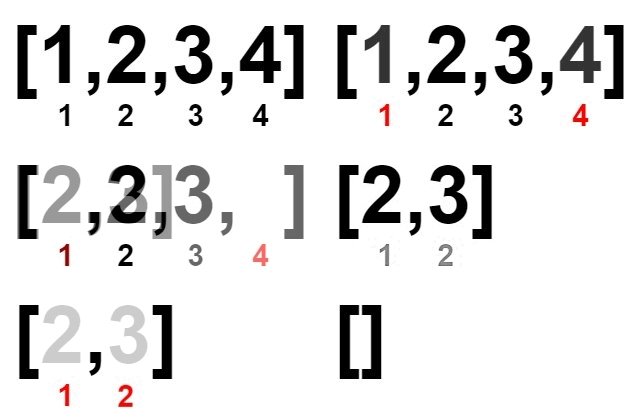
Input: nums = [1,2,3,4]
Output: 0
Explanation:
Example 2:
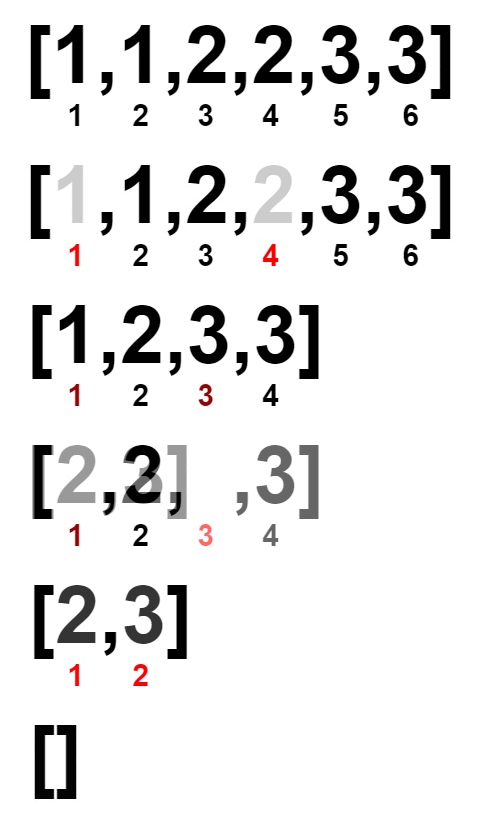
Input: nums = [1,1,2,2,3,3]
Output: 0
Explanation:
Example 3:
Input: nums = [1000000000,1000000000]
Output: 2
Explanation:
Since both numbers are equal, they cannot be removed.
Example 4:
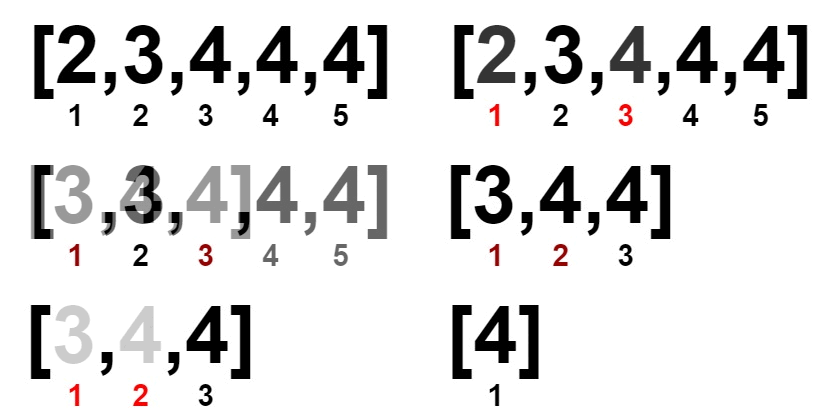
Input: nums = [2,3,4,4,4]
Output: 1
Explanation:
Constraints:
1 <= nums.length <= 1051 <= nums[i] <= 109numsis sorted in non-decreasing order.
Hints
Hint 1
To minimize the length of the array, we should maximize the number of operations performed.
Hint 2
To perform
k operations, it is optimal to use the smallest k values and the largest k values in nums.Hint 3
What is the best way to make pairs from the smallest
k values and the largest k values so it is possible to remove all the pairs?Hint 4
If we consider the smallest
k values and the largest k values as two separate sorted 0-indexed arrays, a and b, It is optimal to pair a[i] and b[i]. So, a k is valid if a[i] < b[i] for all i in the range [0, k - 1].Hint 5
The greatest possible valid
k can be found using binary search.Hint 6
The answer is
nums.length - 2 * k.